Meteor Showers in Big Bend: What's Coming Up and When to Watch
Last updated October 2026 · All times are Central Time for Terlingua, Texas (29.6°N, 103.6°W).
If you're planning a trip to Big Bend National Park and Terlingua, TX and wondering whether a meteor shower lines up with your dates, here's the short answer: you'll see shooting stars out here no matter when you come and the whether the moon is out is the more important question. The longer answer (which showers are worth planning around, what the moon is doing, and whether you need to stay up until 3 AM) is all answered below.
First, the Good News: Meteors Happen Every Night
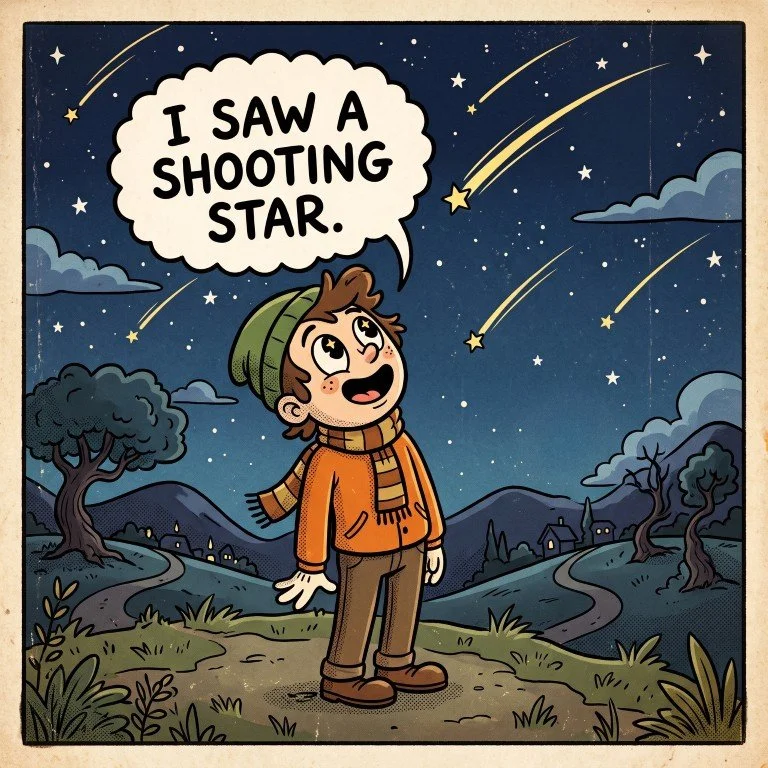
Every night when I’m running one of my my stargazing and telescope tours at Starlingua Ranch, multiple times a night someone will shout out “I saw a shooting star” and anyone who didn’t happen to be looking in the right direction shouts “Where? Where?”. Of course it’s too late by then, the bright streak of light only lasts a second or two. I call it “Mother Nature’s original dopamine hit”. Meteor showers get the headlines, but on any clear, moonless night under Big Bend's sky you'll typically catch around 6 random "sporadic" meteors an hour or about one every 10 minutes. These are bits of space dust that don't belong to any shower. Lie back for an hour on a random Tuesday and you'll be shouting with glee when you see your first one, and it never gets old.
What one of the named meteor showers add is a higher rate hourly rate, concentrated over a few nights each year, with all the meteors streaking away from one point in the sky (the radiant). That's why a shower peak is worth planning around. But a non-shower night in the dark skies of Big Bend will always beat a meteor shower peak under bright city lights.
The Catch: Most Showers Are Late-Night Events
Here's the part most meteor shower articles skip. For the majority of showers, the radiant (the part of the sky the meteors appear to be coming from) doesn't climb high until after midnight, and the hours before dawn are the busiest. That's because after midnight you're on the side of Earth facing forward in its orbit, like a windshield driving into the rain. Before midnight your looking out the proverbial back window of this big car, that we call Earth.
The practical upshot: if you're not a night owl, look for the exceptions. Two of the showers coming up this season are genuinely good before midnight: the Draconids (an evening-only shower) and the Geminids (whose radiant is up by mid-evening). We've flagged them below.
How the Moon Changes Everything
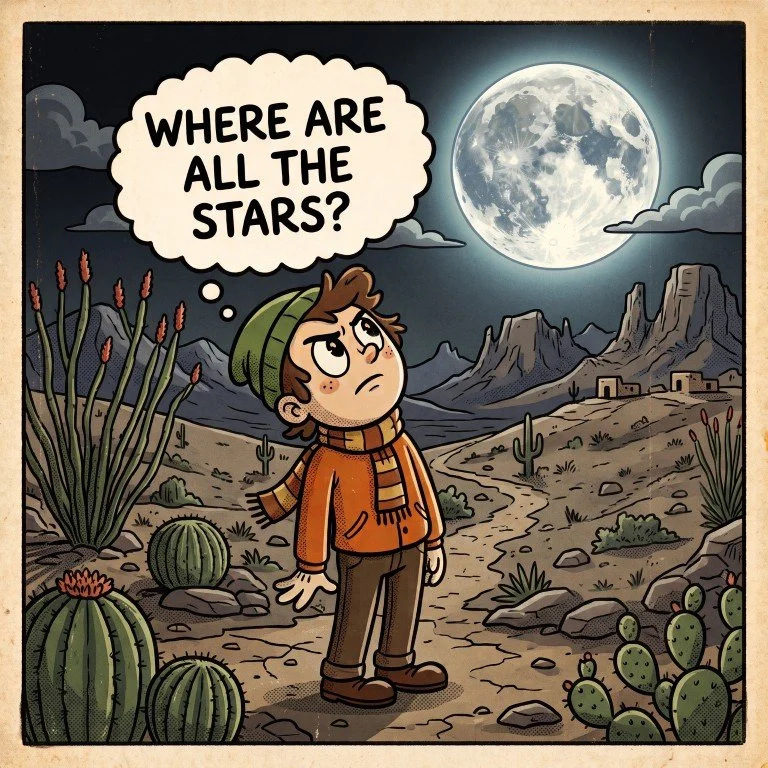
The moon matters more than which shower it is. A bright moon washes out the faint meteors, which are most of them. A shower that could deliver 60 an hour under dark skies might show you a dozen with a full moon up.
The rule of thumb:
New moon or thin crescent: ideal. Dark all night.
Moon that sets early (waxing crescent or first quarter): watch after it sets.
Moon that rises late (waning crescent): watch before it comes up.
Full or nearly full: the shower is mostly a write-off; expect only the brightest meteors.
For each shower below I've worked out exactly when the moon is up or down from Terlingua, so you know your real dark window.
Coming Up: October – December 2026
| Shower | Peak night | Best viewing |
|---|---|---|
| Draconids | Oct 8 | 8:50 – 11 PM |
| Southern Taurids | Oct 10 | All night |
| Orionids | Oct 21–22 | 4:30 – 6:30 AM |
| Northern Taurids | Nov 12–13 | All night |
| Leonids | Nov 17–18 | 1:30 – 5:30 AM |
| GeminidsBest of the year | Dec 13–14 | 10 PM – 6 AM |
| Ursids | Dec 21–22 | Skip this yearNearly full moon |
Planning your trip to Big Bend?
Consider a Private Big Bend Stargazing and Telescope Tour at Starlingua Ranch.
Draconids: October 8 (the evening shower)
The Draconids are the oddball of the meteor calendar: they're best right after dark, not before dawn, because their radiant in the northern constellation Draco sits highest in the early evening. Draco sits between the Big and LIttle Dippers. That makes them the most family-friendly shower of the year.
In 2026 conditions are about as good as they get. The moon is a 3% sliver that's already set, and full darkness arrives around 8:50 PM. The predicted peak lands around 8 PM, right as the sky goes dark. Face north and northwest and give it until about 11 PM.
Set expectations honestly: the Draconids are usually a modest shower, typically under 10 an hour, with the occasional surprise outburst. Think of it as a pleasant evening of scanning the sky rather than a fireworks show.
The Taurids: October and November (fireball season)
The Taurids come in two overlapping branches, Southern (peaking around October 10) and Northern (around November 12), and run at a low rate of roughly five an hour across much of October and November. What makes them worth knowing about is their personality: Taurids are slow, and they're known for producing bright fireballs. A single Taurid fireball crawling across the sky can be the highlight of a night.
Both branches get dark skies this year: the Southern peak falls on the new moon, and the Northern peak has only a thin crescent that sets by 8:30 PM. Because the radiant is up most of the night, these are one of the few showers you can catch during an ordinary evening.
Orionids: October 21–22
The Orionids come from debris shed by Halley's Comet, so every one you see is a tiny piece of the most famous comet in history. They're fast, often leave glowing trails, and typically produce 15–20 an hour under dark skies.
The moon isn't cooperating on the peak night this year. An 81% gibbous moon stays up until 4:24 AM, leaving a dark window from about 4:30 AM until dawn twilight around 6:40 AM. That window is short, but it's also when the radiant near Orion is highest, so consider going to be early and setting an alarm, it's a worthwhile two hours.
The Orionids have a broad, flat peak, so the mornings of October 19 and 20 are a smart alternative: rates are only slightly lower, and the moon sets around 2–3 AM, giving you a longer dark stretch.
Leonids: November 17–18
The Leonids are famous for historic meteor storms (thousands an hour in 1833 and 1966), but in a normal year like this one, expect 10–15 an hour at best. They're among the fastest meteors of any shower, often bright and leaving long trails.
The Leonid radiant rises around midnight, and this year the half-lit moon sets at 1:10 AM, a nice coincidence. Watch from about 1:30 AM until dawn around 5:30 AM, facing east.
Geminids: December 13–14 (the main event)
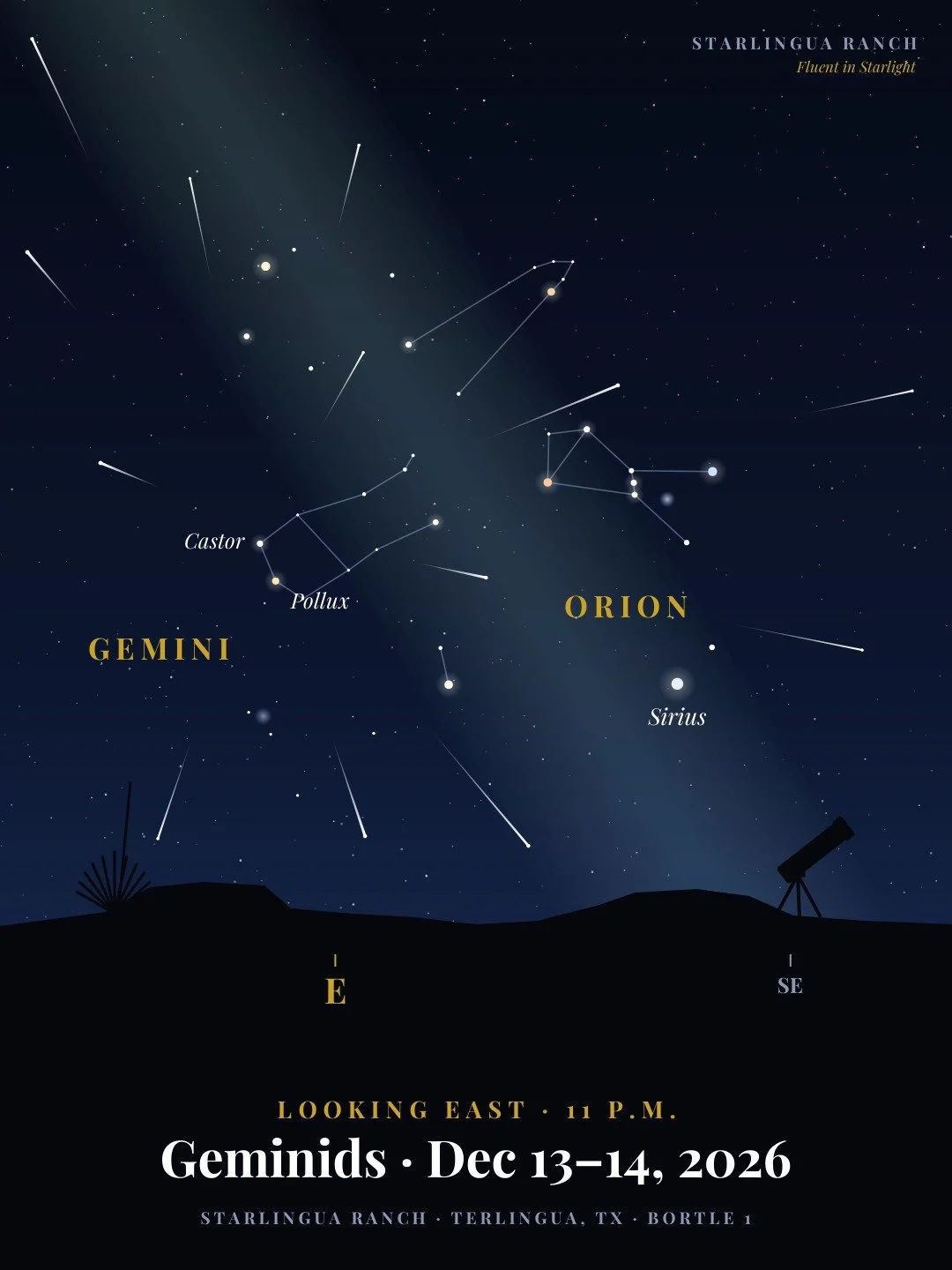
If you can only plan around one shower this season, make it this one. The Geminids are the strongest and most reliable shower of the year, with rates that can top 100 an hour under dark skies, and Big Bend's skies are about as dark as they come.
2026 is an excellent Geminid year. A slim crescent moon sets at 10:06 PM, leaving the rest of the night completely dark. Better yet, the Geminids are the major shower that doesn't require an all-nighter: their radiant near the bright stars Castor and Pollux (the twins of Gemini) is already well up by mid-evening.
10 PM – midnight: Moon gone, rates already strong. The best option if you don't want a late night.
Midnight – 3 AM: The radiant is near its highest; this is the peak window.
The night before (Dec 12–13) is also very good if your dates don't line up with the peak.
One real Big Bend consideration: December nights in the desert get cold, often into the 30s. Dress like you're going ice fishing, bring a blanket, and you'll be fine. The biggest thing that will determine how long you stay out watching, is how comfortable you are.
Ursids: December 21–22 (skip this year)
The Ursids are a small shower to begin with (around 10 an hour), and this year a nearly full moon is up all night. Not worth staying up for in 2026.
Looking Ahead: Quadrantids, January 3–4, 2027
The Quadrantids can rival the Geminids for a few hours, but their peak is famously short. In 2027 the moon is a thin waning crescent that doesn't rise until about 5:20 AM, so the pre-dawn hours (roughly 3–5:15 AM) are dark. We'll cover it in detail in the next update.
The Year at a Glance
| Shower | Typical peak | Best time |
|---|---|---|
| Quadrantids | Jan 3–4 | Pre-dawn |
| Lyrids | Apr 22 | After midnight |
| Eta Aquariids | May 5–6 | Pre-dawn |
| Southern Delta Aquariids | Jul 30 | After midnight |
| PerseidsSummer's big one | Aug 12–13 | After midnight |
| Draconids | Oct 8 | Evening |
| Orionids | Oct 21 | Pre-dawn |
| Taurids | Oct 10 & Nov 12 | All night |
| Leonids | Nov 17 | Pre-dawn |
| GeminidsBest of the year | Dec 13–14 | From mid-evening |
| Ursids | Dec 22 | Pre-dawn |
How to Watch (Spoiler: No Telescope Needed)
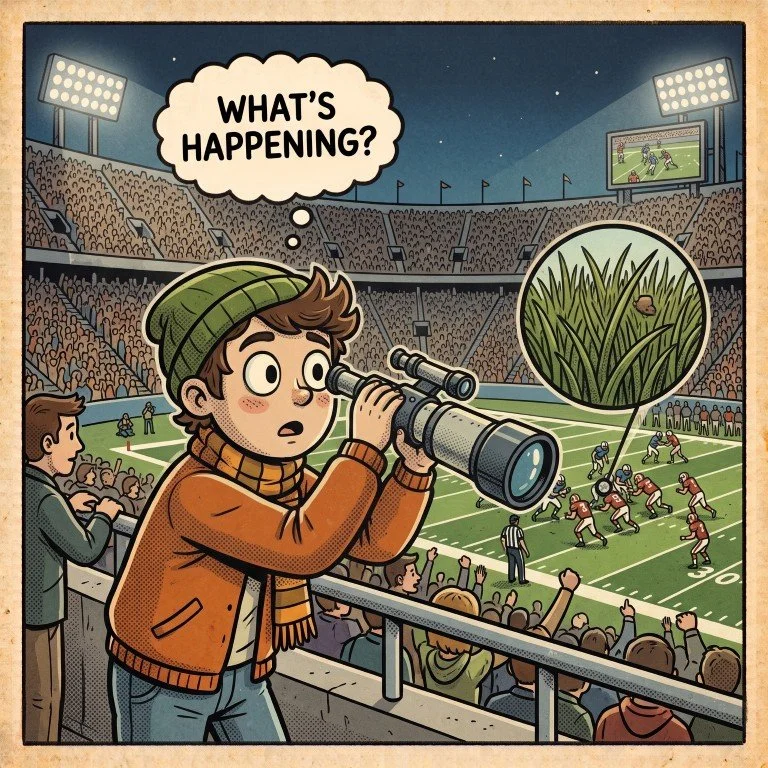
Meteor watching is a naked-eye activity. A telescope shows you a tiny patch of sky, and meteors can appear anywhere.
Get comfortable. A reclining or zero-gravity chair is the single best piece of gear. You'll be looking up for an hour or more. And the ground is usually cold and sometimes crawling with big spiders or snakes.
Don't stare at the radiant. Just look up at the biggest patch of sky you can with relaxed vision.
Don’t give up too early, give your eyes 30 minutes to adjust, and keep your phone away. One glance at a bright screen resets the clock. Use a dim red light if you need one.
Give it some more time, patience is a virture. Meteors come in clumps and lulls. Plan for at least an hour.
Binoculars are a nice extra, if you have kids or have ADHD, for exploring the Milky Way and star clusters between meteors.
Dress for the desert night. Even after warm days, temperatures drop fast once the sun goes down, especially from November on.
Why Big Bend National Park Is the Best Place in the World to Watch from
Big Bend National Park and Terlingua, TX sit inside the Greater Big Bend International Dark Sky Reserve, the largest certified dark-sky reserve in the world. The skies here are dark enough to show the faint meteors that get washed out everywhere else and most people never see, which is why a modest shower like the Orionids or Leonids can feel surprisingly busy out here.
You don't need a special spot: anywhere in the park or around Terlingua away from headlights and other bright lights will do. Pick a place with a wide-open view of the sky, meaning away from a building, trees, or mountain that block the horizon.
Make a Night of It
If your Big Bend trip lands on a shower night (or any clear night), consider adding a guided evening under the stars. At Starlingua Ranch, our private stargazing tours (one group per night) pair the naked-eye sky with live telescope views of nebulae, galaxies, and star clusters from our ranch north of Terlingua.
Find your night for a private stargazing tour in Big Bend.
Clear skies.
