Can You See Saturn’s Rings Without a Telescope? A Big Bend Guide
Short answer: No you can’t. And actually binoculars won’t get you there either. Your going to need a telescope, and like most things in life the bigger the better. Through a telescope, Saturn looks like a tiny, perfect version of the pictures from Instagram: a pale gold globe wrapped in a sharp, bright ring, floating in a black sky. Most people gasp the first time they see it in person with their own eyes, because it looks almost too real to be real.
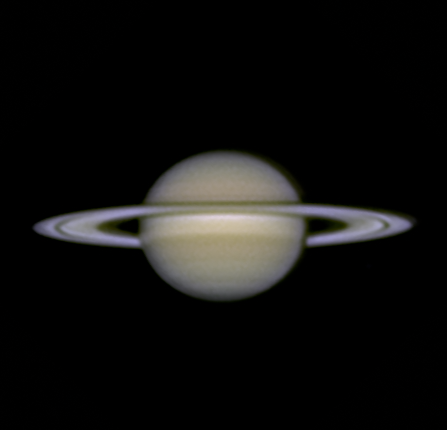
Photo: Saturn from Starlingua Ranch, October 19, 2026
This photo was taken through the same telescope our guests look through on tours. Believe it or not, it looks even better in person looking through the eyepiece of the telescope. A camera has to average out the shimmer of the atmosphere, while your eye catches the moments when the air goes still and the view snaps into focus.
What will I actually see through the telescope?
Saturn is small but bright in the eyepiece of the telescope, but every part of it is unmistakable. Here is what you can typically pick out, from easiest to hardest:
The rings. They stand clearly apart from the planet, with a slice of black sky visible between ring and globe on each side.
Color. The globe is a soft butterscotch or cream, and the rings look a cooler gray. It is subtle, not the saturated colors of spacecraft photos.
Titan. Saturn's largest moon looks like a small star sitting off to one side. On steady nights a few fainter moons show up too.
Shadows. The rings cast a thin shadow line across the globe, which gives the planet a real sense of depth.
Bands. Faint tan stripes run across the globe, with a brighter zone near the equator.
The Cassini Division. A thin dark gap splitting the rings in two. It pops into view in the moments when the air steadies.
The trick is patience. The atmosphere shimmers, so the view comes and goes. Keep looking for 20 or 30 seconds and you will catch the moments when everything sharpens at once.
Why do the rings look thin right now?
In March 2025 they lined up exactly edge-on with Earth and almost vanished from view. The rings are currently tilted only about 7 degrees toward us this fall, so they are slowly opening back up from our perspective. It will take a few years to get back to the wide open hoop you may remember from grade school pictures.
Saturn takes 29.5 years to orbit the Sun, so the rings go edge-on roughly every 15 years and slowly open up in between. They will tilt to about 13 degrees by next fall and reach their widest, around 26 degrees, in 2031. We are currently looking at the rings from slightly below, which is why more of Saturn's southern half shows beneath them.
Thin rings have a bonus: the gap between ring and globe and the shadow across the planet are easy to see, and the view changes a little every year.
When and where can I see Saturn in Big Bend tonight?
Saturn is visible for about half the year. When Saturn is up, it is the highlight of the night on our Big Bend Stargazing Tours, and every guest gets a good long look at the rings through the telescope.
Saturn's season in the evening sky runs roughly from late summer through February. Fall and early winter are prime Saturn season, no need to stay up late to see it. In spring and early summer Saturn is too close to the Sun to see, and the telescopes turn to other showpieces like star clusters, nebulae, the Moon, and other planets when they are up.
Here is the outlook for this year:
| Month | Saturn during evening tours | Sets around |
|---|---|---|
| Oct 2026 | All tour long | After sunrise |
| Nov 2026 | All tour long | 4:00 am |
| Dec 2026 | All tour long, best month | 2:00 am |
| Jan 2027 | Early in the tour | Midnight |
| Feb 2027 | First stop after dark | 10:00 pm |
| Mar to mid-Aug 2027 | Not visible | Not visible |
Saturn viewing FAQ
Can you see Saturn without a telescope?
Yes, but not the rings. It looks like a bright, steady, slightly golden star that does not twinkle the way stars do.
Can you see Saturn's rings with binoculars?
Only if your binoculars are really big! Binoculars may show Saturn as slightly oval, but the rings only separate from the planet starting at 25x magnification.
What color is Saturn?
A pale butterscotch or cream, with faint tan bands and grayish rings. The colors are soft and natural, gentler than most photos.
Does Saturn look better in person or in photos?
Most guests are shocked by what they see through the telescope. Saturn through a high power telescope is mind blowing.
When will Saturn's rings be wide open again?
They are opening a little more each year and will be at their widest in 2031 and 2032.
