May 2026 Sky Targets
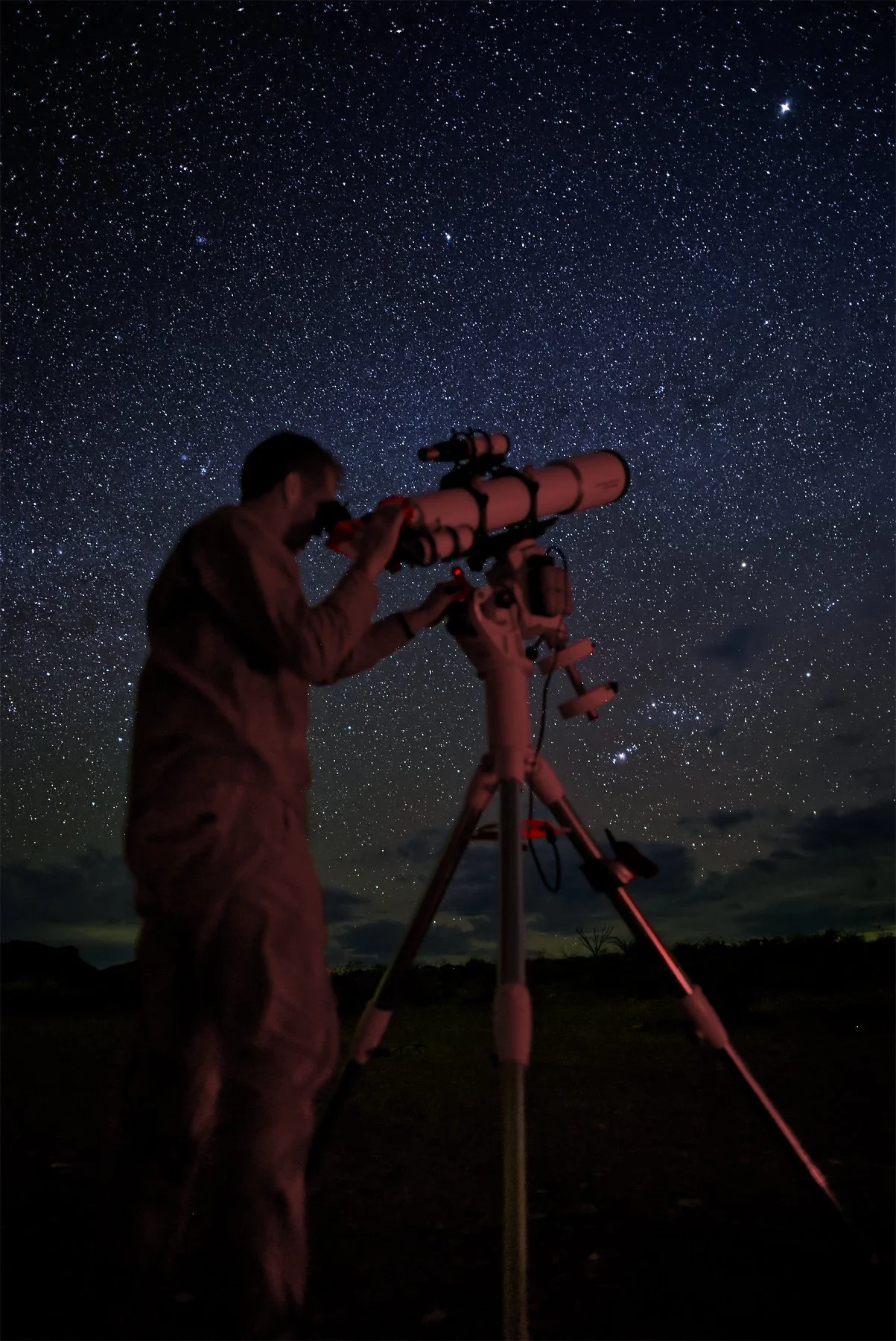
The best nights for stargazing in May aren't the ones you'd expect.
It's tempting to run outside on a clear evening and just look up, but a little planning turns a good night into a memorable one. The sky has a schedule. The moon has moods. And the objects most worth seeing through a pair of binoculars are usually the ones nobody's pointed out to you.
Every month, we publish a short guide to what's worth finding overhead — targets chosen for 30–35° latitude (that's most of the southern U.S.), visible between roughly 10 PM and midnight, and genuinely rewarding through ordinary binoculars. No chasing objects you'll never find. No "look, the Moon." Just a curated handful of objects most people walk right past.
Here's what's worth your time this month.
When to go out in May
The dark window is May 11–20, centered on the new moon on May 16. That's the best week of the month for faint targets. Outside that window, moonlight will wash out anything subtle.
If you're only going to go out once, aim for May 15, 16, or 17. No moon, warm nights, and — if you stay up late — the summer Milky Way starting to rise in the east.
Worth setting an alarm for: the Eta Aquariid meteor shower peaks May 5–6 in the pre-dawn hours, with up to 50 meteors per hour from a truly dark site. It's debris from Halley's Comet. You'll need to be up around 3–5 AM for the best show, but it's one of the year's most reliable meteor showers.
Target 1 · Omega Centauri — the southern giant
Want to see how visibility changes with your latitude? We built an interactive visual tool — drag a line across North America or pick a city to see exactly how Omega Centauri sits in your sky. Explore the guide →
Low on the southern horizon around 10 PM · Look for a bright, round, slightly fuzzy "star"
Omega Centauri is the largest and brightest globular cluster visible from Earth — a swarm of roughly ten million stars packed into a tight sphere 17,000 light-years away. From Texas latitudes it rides low in the south in spring, which makes it one of the hardest-to-see wonders of the sky for most Americans. From a truly dark site, it's a naked-eye fuzzy spot. Through binoculars, it's a bright, grainy ball of light that starts to resolve into individual stars if the air is steady.
Look due south around 10 PM. It'll sit roughly 15 degrees above the horizon — lower than that, and atmospheric haze starts to eat into the view. You're looking below the constellation Centaurus, a constellation most northern stargazers never see at all.
Worth knowing: Omega Centauri is now believed to be the stripped-down core of a dwarf galaxy our Milky Way swallowed billions of years ago. You're looking at the fossil of another galaxy.
Bonus · The Moon, Venus, and Jupiter — a rare three-way
Low in the west after sunset on May 18 and 19
Not always on these lists — but this month, the western sky delivers a genuine show. On the evenings of May 18 and 19, a thin waxing crescent moon slides between Venus and Jupiter, the two brightest planets in the sky. The naked-eye view is striking enough to stop traffic; with binoculars, you get the bonus of seeing Jupiter's four Galilean moons lined up like beads on either side of the planet.
Look west within an hour after sunset. No dark sky required — you can see this from a parking lot in the city. But at a dark site, the backdrop of stars coming out behind the conjunction makes it unforgettable.
Worth knowing: When Galileo first saw those four moons through his telescope in 1610, it was the first direct evidence that not everything in the solar system orbits Earth. Modern astronomy arguably begins at that moment.
Three more targets — delivered to your inbox
The other three targets for May are deep-sky objects worth knowing by name: a 300,000-star cluster that Galileo puzzled over, a nearby star cluster that fills half your binocular view, and a swarm so dense the ancient Greeks recorded it as a cloud in the sky.
Each month, we send a free list of four to five binocular-friendly targets chosen for Texas skies — timed to the new moon, written to be genuinely useful, and limited to the non-obvious objects most guides skip.
A note from the ranch
These targets are all within reach of anyone with a pair of binoculars and a dark sky. What you can't see with binoculars — the faint galaxies, nebulae, and star-forming regions that live beyond what any handheld tool can reach — is what we spend our evenings showing guests at Starlingua Ranch.
We sit inside the Greater Big Bend International Dark Sky Reserve in one of the darkest spots in the Lower 48, off Terlingua Ranch Road about 15 minutes north of the Ghost Town. Max four guests per session. Zero-gravity recliners. Traditional telescopes paired with live deep-sky imaging streamed to a tablet in your lap — so you stay looking up while galaxies appear beside you.
If you're ever coming through the Big Bend area, we'd love to show you the sky.
Until June — clear skies.
